
Free-Space Optical Modulators
Our resonant phase/polarization/intensity modulators represent a breakthrough in free-space optical modulation technology. By leveraging resonant collinear acousto-optic interactions within sub-millimeter optically isotropic piezoelectric crystals, we've achieved a performance regime previously unattainable:
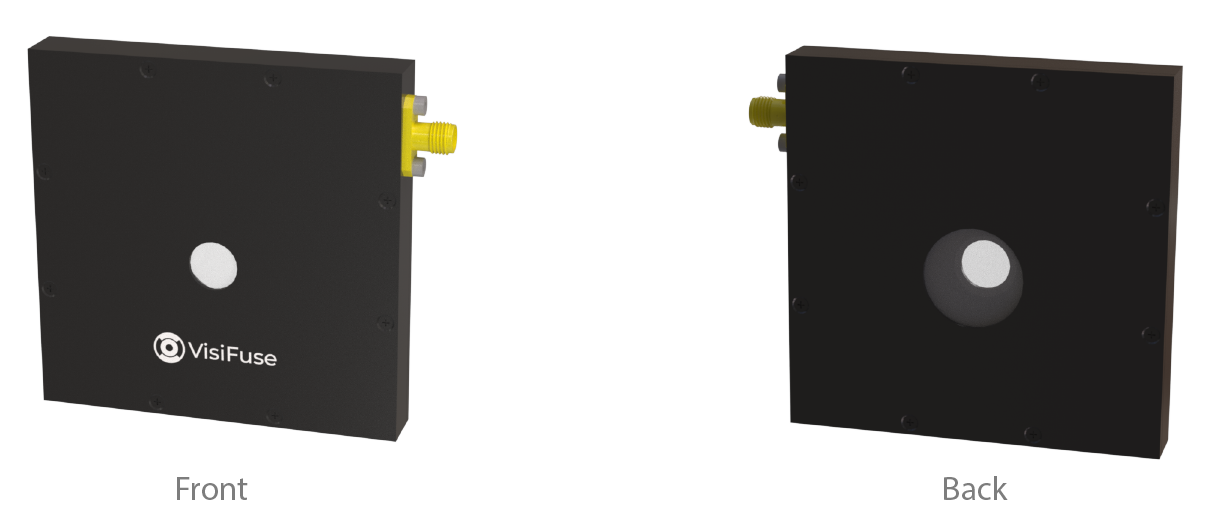
Technical Overview
These modulators use sub-millimeter, high-purity optically isotropic piezoelectric crystals to achieve resonant collinear acousto-optic interactions across centimeter-scale apertures at megahertz frequencies. The resonant structure's high mechanical quality factor enables sub-watt drive power with standard 50 Ω impedance matching—eliminating complex high-voltage electronics. Integrated frequency tracking ensures stable performance across varying temperature and drive power conditions.
Traditional modulation technologies face fundamental trade-offs. Liquid crystal and traditional photoelastic modulators are limited to kilohertz frequencies, while electro-optic and conventional acousto-optic modulators can reach megahertz speeds but require thick crystals and high voltages when scaled to centimeter-scale apertures and are constrained to narrow acceptance angles. Our architecture is the first to simultaneously achieve all critical performance parameters in a single platform.
Key Advantages
- 10X thinner crystals compared to electro-optic & acousto-optic modulators
- 100X lower drive voltage compared to electro-optic modulators & 10X lower drive voltage compared to acousto-optic modulators
- 10X wider acceptance angle compared to electro-optic & acousto-optic modulators
Performance Specifications
- Resonant operating frequencies: 2.8 MHz (930–1600 nm) and 3.5 MHz (600–930 nm).
- Insertion loss: < 0.3 dB (phase/polarization modulators), < 1.2 dB (phase & polarization modulators with integrated polarizers), < 2.2 dB (intensity modulators) across full acceptance angle and spectral range.
- Acceptance angle: Up to ±30° for applications demanding wide acceptance angles.
- Aperture: 10.2 mm diameter clear aperture with > 90% modulation uniformity.
- Drive power: Sub-watt RF power achieves up to π/4 radians phase shift, π/2 radians polarization rotation, or >20 dB extinction ratio across full angular and spectral range; intermediate modulation depths require proportionally less drive power.
- Optical power handling: Multi-watt optical power handling capability.
- Drive interface: Standard 50 Ω matched SMA connector—no complex drive electronics required.
- Polarization stability: Non-birefringent crystal eliminates undesirable temperature, angular, and spectral induced polarization shifts.
- Temperature stability: Resonant frequency tracking maintains consistent operation over wide temperature ranges.
Operating the Modulator
The modulator connects via a standard SMA interface for straightforward integration into RF drive systems. Each unit's resonant frequency varies slightly from the nominal specifications (2.8 MHz or 3.5 MHz) due to natural variations in crystal thickness and material properties. To achieve optimal performance, we guide customers through setup and can provide the necessary RF hardware and stabilization software for the thermal burn-in procedure. This process brings the modulator to thermal equilibrium via passive cooling and determines the precise operating frequency for that specific unit, which then remains fixed during operation.
Once the operating frequency is established, the modulator requires only a standard RF signal at the determined frequency with sub-watt power levels. The integrated frequency tracking system maintains stable operation across temperature variations during normal use.
Mechanical Design
All modulators share a standardized housing for easy integration:
- Dimensions: 76.2 × 76.2 mm footprint, 11.4 mm thickness.
- Enclosure material: Black anodized aluminum.
- Mounting: 8-32 threaded holes.
- RF connection: Standard SMA connector.
Product Portfolio
Phase Modulators
- • Phase modulation depth up to π/4 radians across the complete angular and spectral operating range with sub-watt RF drive power.
- • Integrated polarizers oriented at the optimal angle (indicated by alignment marking on front aperture) enable operation with arbitrarily polarized incident light. Insertion loss is a function of the overlap between input light polarization and the indicated alignment marking on the enclosure indicating polarizer transmission axis.
- • Insertion loss below 1.2 dB maintained across the full angular and spectral coverage region when linearly polarized input light is aligned with the polarizer transmission axis as indicated by the alignment mark.
Available Models
- F1-C1 (3.5 MHz, 600 nm - 930 nm)
- F1-C2 (2.8 MHz, 930 nm - 1300 nm)
- F1-C3 (2.8 MHz, 1300 nm - 1600 nm)

Polarization Modulators
- • Polarization modulation depth up to π/2 radians across the complete angular and spectral operating range with sub-watt RF drive power.
- • Integrated polarizers oriented at the optimal angle (indicated by alignment marking on front aperture) enable operation with arbitrarily polarized incident light. Insertion loss is a function of the overlap between input light polarization and the indicated alignment marking on the enclosure indicating polarizer transmission axis.
- • Insertion loss below 1.2 dB maintained across the full angular and spectral coverage region when linearly polarized input light is aligned with the polarizer transmission axis as indicated by the alignment mark.
Available Models
- P1-C1 (3.5 MHz, 600 nm - 930 nm)
- P1-C2 (2.8 MHz, 930 nm - 1300 nm)
- P1-C3 (2.8 MHz, 1300 nm - 1600 nm)

Phase/Polarization Modulators
- • Configurable modulation depth: π/4 radians (phase mode) or π/2 radians (polarization mode) with sub-watt RF drive power, selectable based on input polarization state.
- • Exceptionally low insertion loss below 0.3 dB across the complete angular and spectral coverage region, independent of input polarization state.
- • Clearly marked phase and polarization axes provide operational flexibility, enabling pure phase modulation, pure polarization modulation, or hybrid operation tailored to application.
Available Models
- FP1-C1 (3.5 MHz, 600 nm - 930 nm)
- FP1-C2 (2.8 MHz, 930 nm - 1300 nm)
- FP1-C3 (2.8 MHz, 1300 nm - 1600 nm)

Intensity Modulators
- • Extinction ratio up to 20 dB achievable with sub-watt RF drive power.
- • Integrated polarizers oriented at the optimal angle (indicated by alignment marking on front aperture) enable operation with arbitrarily polarized incident light. Insertion loss is a function of the overlap between input light polarization and the indicated alignment marking on the enclosure indicating polarizer transmission axis.
- • Insertion loss below 2.2 dB maintained across the full angular and spectral coverage region when linearly polarized input light is aligned with the polarizer transmission axis as indicated by the alignment mark.
Available Models
- A1-C1-I (3.5 MHz, 600 nm - 750 nm)
- A1-C1-II (3.5 MHz, 750 nm - 930 nm)
- A1-C2-III (2.8 MHz, 930 nm - 1100 nm)
- A1-C2-IV (2.8 MHz, 1100 nm - 1200 nm)
- A1-C2-V (2.8 MHz, 1200 nm - 1300 nm)
- A1-C3-VI (2.8 MHz, 1300 nm - 1450 nm)
- A1-C3-VII (2.8 MHz, 1450 nm - 1600 nm)
